Verifiable rewards have advanced reinforcement learning in mathematics
and code. Open-ended generation, however, has
no automatic verifier of overall quality: a response
must satisfy multiple requirements, and many different responses can
be valid. Rubric-based reinforcement learning makes these requirements
explicit, but learning progresses unevenly. Some criteria become fully
satisfied and
lose their ability to distinguish outputs, while
others remain informative. We introduce
Reinforcement Learning with Adaptive Rubric Evolution
(RARE), which uses current-policy feedback to guide
which criteria change and what their replacements assess. At the sample level, RARE replaces criteria that are fully
satisfied across a query’s current outputs with checks of remaining
quality differences. It
retains all other criteria and scores, preserving
feedback that still distinguishes outputs. Within this update rule, we
compare rewarding desired qualities with penalizing observed flaws. We
study video script generation, where a model must produce coherent,
executable narratives under user constraints. Across
2D animation, 3D / stop-motion, and live action,
targeting observed flaws performs best, with a mean gain of
3.82 points over matched static rubrics. Model and human preferences support these gains, and separate
experiments show improvements on writing and general generation
benchmarks. We release the training code and
5,989 query–rubric pairs.
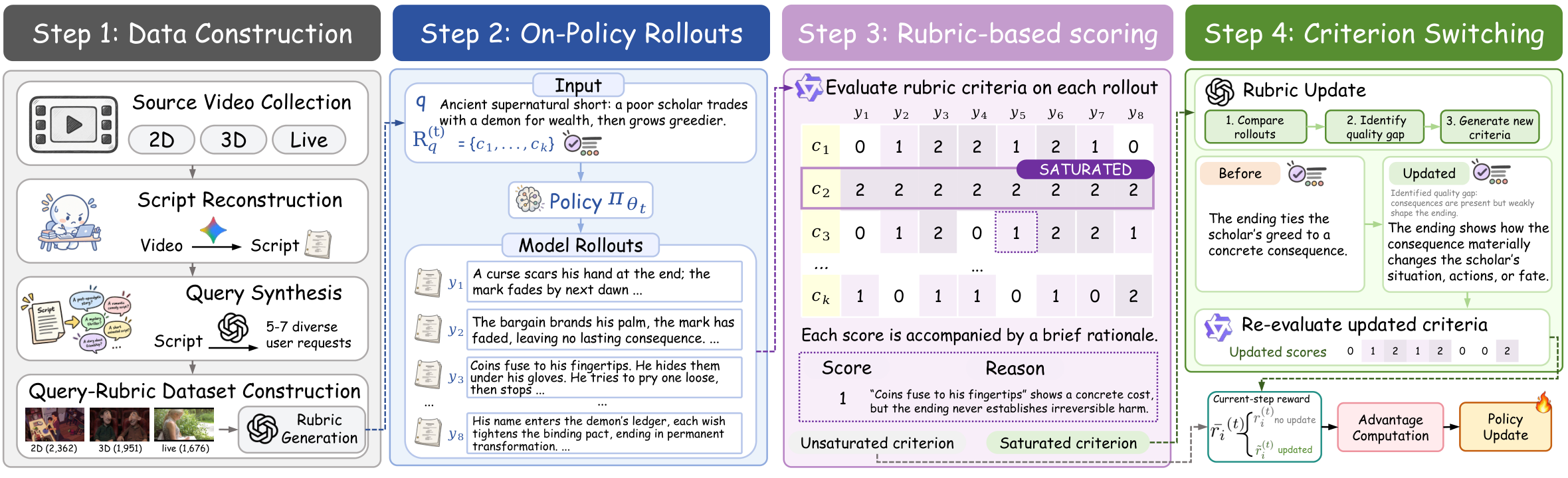
Adaptive rubric evolution
For each query, RARE samples eight outputs and
scores them against the current rubric. A criterion is saturated
when all eight valid judgments assign its maximum score. RARE
replaces up to three saturated criteria,
rescores the same outputs
under the replacements, and uses the updated rewards in the current
policy update.
Figure 1. Sample-level RARE replaces saturated criteria while
retaining other feedback.
Illustrated on script generation, the generator proposes
replacements from rollout differences. The judge rescores the
replacements on the same responses before the policy update.
RARE · Negative
Targets observed flaws in the current outputs.
RARE · Positive
Describes desired qualities the outputs should satisfy.
RARE · Mixed
Combines flaw-focused and desired-quality criteria.
These three sample-level variants use the same replacement rule.
Higher reward scores always indicate better quality.
Results
Script generation
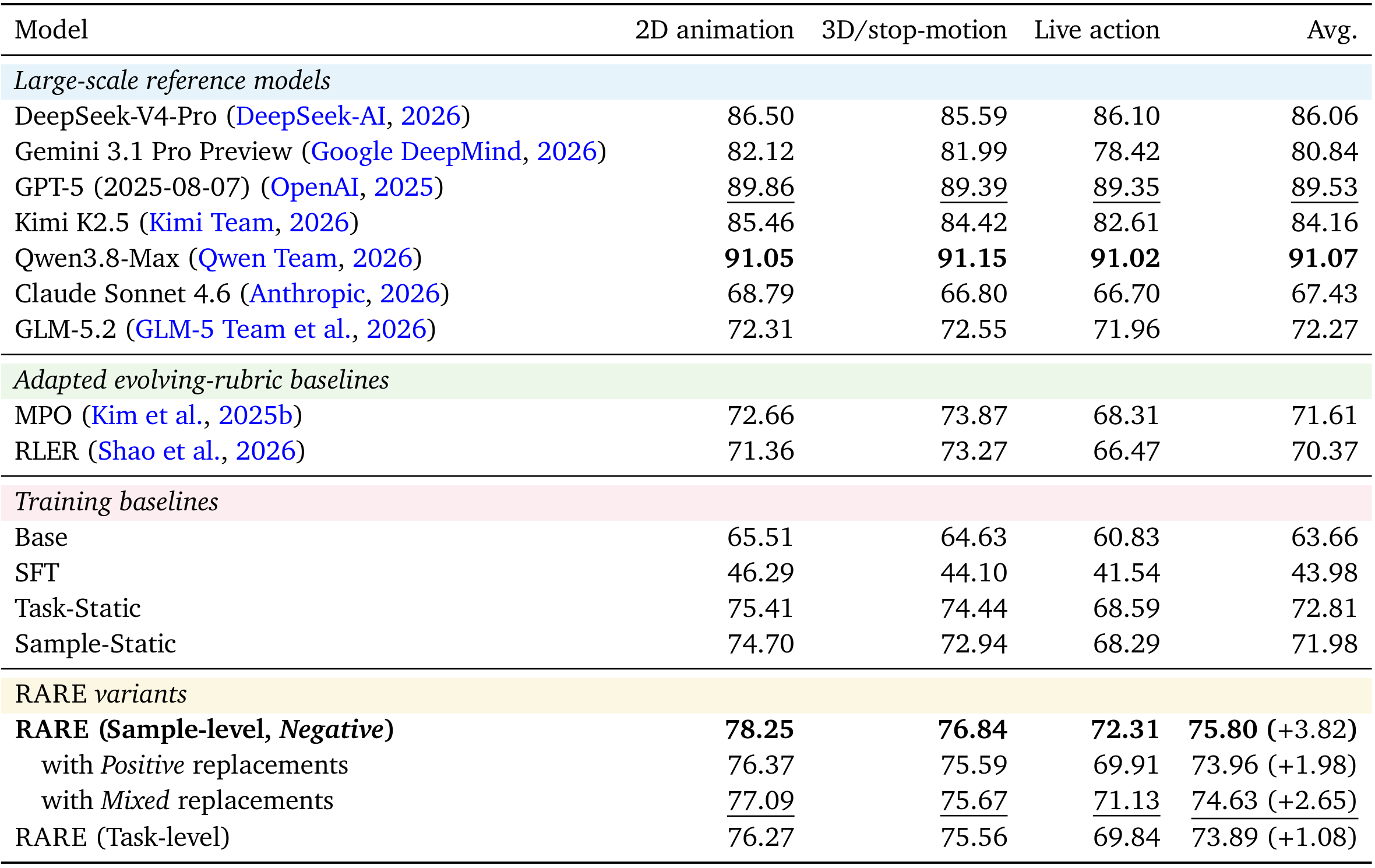
We evaluate on 596 held-out queries using 12 fixed
metrics covering query fulfillment, narrative coherence, cinematic
executability, and dramatic effectiveness. Scores are normalized to
0–100; RL results average four training seeds.
RARE with Negative replacements improves all three tasks
and achieves the largest mean gain over its matched static baseline.
Table 2. RARE improves over matched static baselines.
Scores are query averages within each video type. Avg. gives equal
weight to the three types. RL results average four seeds.
Parentheses show gains over the corresponding static baseline at the
same update level.
Pairwise preference
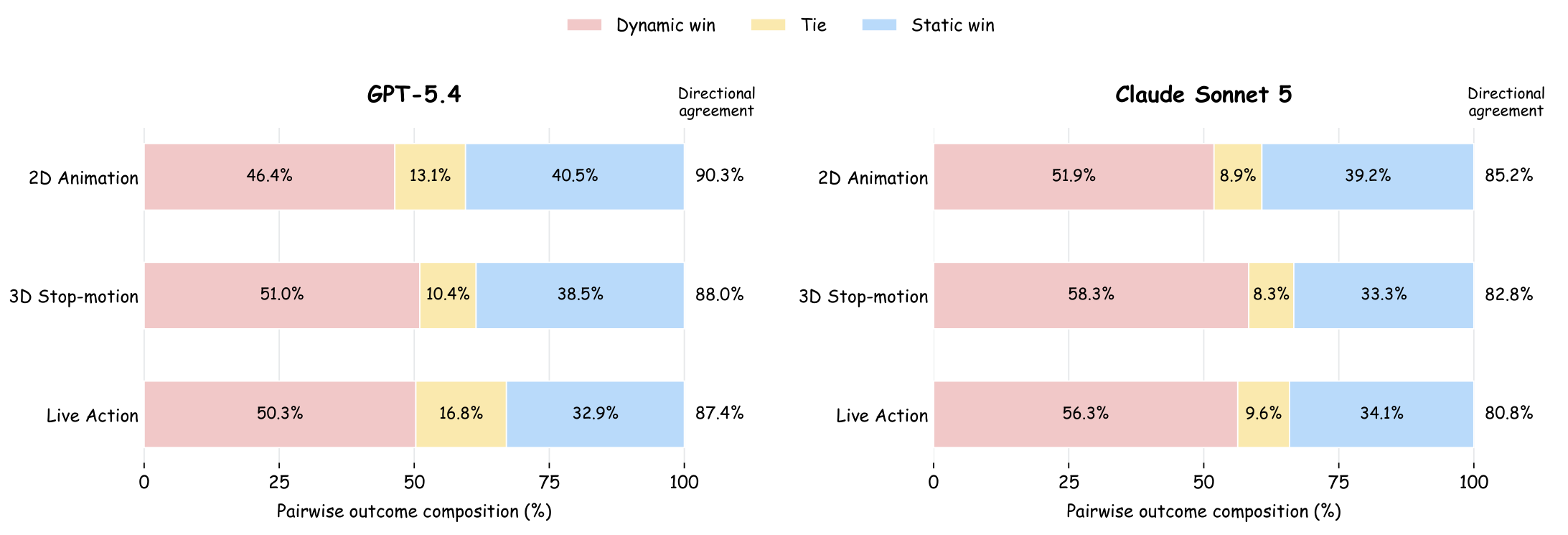
GPT-5.4 and Claude Sonnet 5 blindly compare RARE (Negative) with
Sample-Static on all 596 test queries, in both script orders.
Both judges favor RARE in every video type.
More than 80% of preferences agree after reversing script order.
Figure 5. Both judges favor Negative.
Dynamic denotes RARE (Negative); Static denotes Sample-Static.
Directional agreement measures consistency after reversing the
presentation order.
Human preference
Five computer science PhD students blindly judge 60 script pairs,
with three independent ratings per pair. Majority votes favor RARE
in 38 pairs and Sample-Static in 13, leaving nine ties or
unresolved cases.
70.8% preference score when
ties and unresolved cases count as half a win (95% bootstrap CI:
60.0–80.8%).
Beyond script generation
Separate policies trained for writing and general generation also
benefit from rubric evolution.
Model
BiGGen 1–5
WritingBench 1–10
Base
4.035
8.22
Static
4.152
8.26
RARE (Negative)
4.259
8.34
Table 4. Official benchmark macro averages; each task uses
matched data and training settings.
Script examples
Nine selected prompts, with outputs from the initial model and
RARE.
Language
English translations of the Chinese outputs. Scores evaluate the
original scripts.
These examples compare the initial model with RARE. They are
selected individual outputs; aggregate comparisons with
static-rubric training appear in the Results section.
 RARE: Reinforcement Learning
with Adaptive Rubric Evolution
RARE: Reinforcement Learning
with Adaptive Rubric Evolution